Shooting Percentage vs Age
There was some discussion the other day about whether shooting percentage should go up as a player ages, presumably hitting a peak in his mid-20s. If we look at players who starting playing in the NHL at age 21 or younger, this is certainly not true:
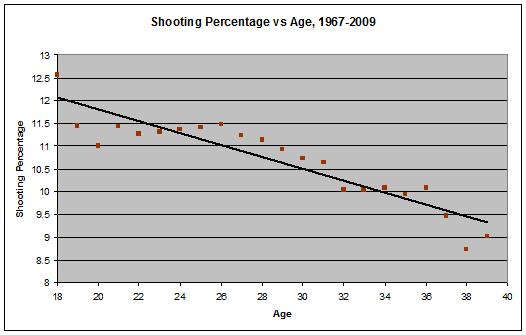
Shooting percentage is essentially constant from Age 19 to 26, and then it begins a long, slow decline. What does increase, however, is the number of goals scored per game - because the number of shots taken per game goes up much faster than shooting percentage drops:
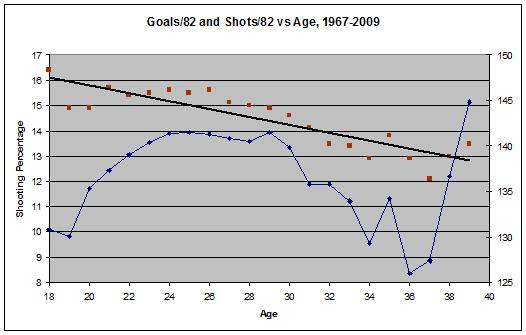
We can slice and dice this data looking for other trends, but what I've shown here remains true pretty much no matter what you do. If a player has been in the NHL for a few years and his shooting percentage goes way up one season, there is absolutely no reason to believe that it represents a change in ability - most likely it's a change in usage or just a case of making his shots in one particular season. It is certainly not something that we expect based on aging curves for typical players.

10 comments
|
0 recs |
Do you like this story?
Comments
Good Stuff
Taking this and the average pgg model (peak years 25-26-27), its pretty clear that this is consistent no matter what. What I have found using the peak years theory is that around age 30 or 31 a there is a little bump back to the peak years (as the first chart somewhat indicates) and then possibly another bump in the later 30’s (35-36).
Good for my fantasy hockey evaluations – so thanks!
Blueshirt Banter - End the Sather Era
US Soccer - The Yanks Are Coming
Red Sox Fan behind Enemy lines.
This is by far your coolest work this year.
On another note, it’s good to know that I still have a couple years left to dominate my bar league.
Bettman's Nightmare: A Blog Where Hockey Aficionados Dismantle That Mighty Empire, One Balsillie at a Time
http://bettmansnightmare.blogspot.com/
by Bettman's Nightmare on Apr 15, 2010 10:37 AM EDT reply actions
2nd Graph unclear
1st graph is cool and extremely original (I’ve never seen anyone plot this before). I learned something useful today about NHL players.
2nd graph—is that shots per game on the right hand side? Obviously nobody is taking 125 shots per game, so should that read 1.25 shots per game or is that pro-rated season number, as in “125 shots per 82 games played”?
All things Thrashers + stats: www.birdwatchersanonymous.com
Am I the only one completely confused by Crosby’s season this year?
His shooting percentage is way up, but so are his shots (about 20% more per game). His assists are way down, almost developing a bit of a trend over the past few seasons and isn’t he at an age where assists per game typically increase?
I realize there is probably a lot of noise in there, but have his shots gone up enough and assists decreased enough to indicate that he is playing completely differently than before?
Gabe, explain to me what I’m not getting. You’re calculating the average shooting percentage of all players of a given age in the NHL. Isn’t this selection bias, i.e. only the best 19-year-olds will be in the league, etc. If you calculate the PPG of players from 18 to 26 you’ll also find they’re constant even though these players obviously improve over this time. What did I miss?
I have a similar concern. How did you do the analysis? If you did a simple regression, I think you miss some potential confounding variables. Specifically, what if players who enter the league at 18 have a higher intrinsic shooting percentage than the players who enter the league at 22 or 23. As the older players enter the league, the average for the age cohort would appear to go down, when in fact it was being diluted. Do you run this as a time series? That would compare each player to their younger selves.
by DoctorMyBrainHurts on Apr 15, 2010 10:39 PM EDT up reply actions
I am taking all players who premiered at age 20 or less and looking at their shooting percentage as they age.
In my previous post on the Caps, one of the commenters alleged that shooting percentage would rise for players like Nicklas Backstrom (who broke into the league at age 20) as they aged. So the selection bias is intentional; players who show up at age 23 are not supposed to be in the sample at all.

by 


