When do NHL Teams play for the tie?
Some of you might think that my blog is about 50% about NHL overtime. I'll admit it's pretty close. But I'm intrigued by the strange incentives that the extra point bring to the table. I've seen several people suggest that teams are more likely to play for the regulation tie and overtime point later in the season - as the playoff hunt really heats up and an extra point has a higher apparent value. This seems to be true since the lockout:
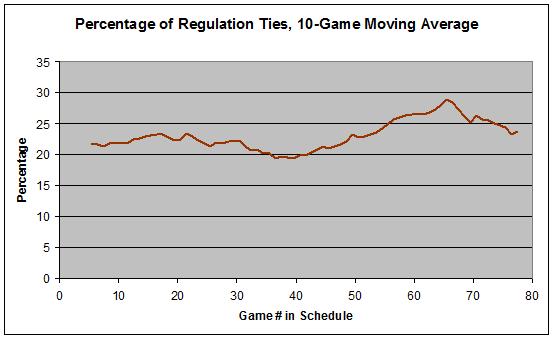
Regulation ties are fairly constant throughout the season, until there are about 25 games to play. Bubble teams play to maximize their points in the standings, which results in more regulation ties, and thus more points in the standings. This strategy peaks with 15 games to go and drops off as fewer and fewer playoff spots are under contention.
This situation did not exist prior to the lockout. After the introduction of the overtime loss in 1999-00, there was no explicit effort to play for the extra point. Most of the time, a tied regulation game ended up in a tie after overtime, so incentives were quite a bit less. Prior to 1999, there were no extra points, and teams did not use the tie strategically.
I suppose the positive outcome here is that teams do behave rationally in response to the extra points system!

2 comments
|
0 recs |
Do you like this story?
Comments
Most teams respond by sitting back but it would be interesting to see this broken down on a team-by-team or coach-by-coach basis. Are there some bubble teams that seem to have fewer regulation ties than others? Which ones? This season the Canucks have only played 5 overtime games all year, by far the lowest in the league. Is there evidence that they’re more aggressive at the end of games? Does this usually result in more wins or more losses before overtime? (I’d guess it results in more wins).
On the overall point that teams play for the tie late in games and moreso later in the season, it’s undeniably true. I’m just waiting for a game between, say, the Flames and Canucks on the last day of the season where the Flames need one point to make the playoffs and the Canucks need one point to win the division. What do you figure the odds are that game goes to overtime? In that situation it wouldn’t make a difference if they used the current system or the old two-point must system where ties garnered one point for each side. The problem with the current system is it makes the unlikely situation above (where both teams benefit from “working together”) common-place. Both teams almost always benefit when they reach overtime (though as you’ve shown the inferior team benefits a lot more).
Thansk for this, Gabe. I had done a detailed study of a couple seasons which showed the percentage of three-point games mounting during the season, but your simple graph with 4-5 years results embedded in it tells a thousand words.
The system is a freaking joke.
Writer for The Copper & Blue and primary shareholder of Zorg Industries
"Never be ashamed of who you are" -- Jean-Baptiste Emanuel Zorg

by 


