Navigation: Jump to content areas:


Pro Quality. Fan Perspective.
Login-facebook
Around SBN: Transfer Rumor: Bolton On Verge of First Signings

12/17/10 Det-Chi Passing

CHICAGO IL - DECEMBER 17: Tomas Kopecky #82 of the Chicago Blackhawks scores a goal against Jimmy Howard #35 of the Detroit Red Wings in the 2nd period at the United Center on December 17 2010 in Chicago Illinois. (Photo by Jonathan Daniel/Getty Images)

Back in December, I put out feelers for people to score the 12/17 Detroit-Chicago game.  I even offered to pay.  I ended up with data for the third period of the game that's an absolute treasure trove.  (In case you ever want to do it yourself, a Hawks fan - known only as E. Gao - spent 18 hours recording the data.)

I have weeks of analysis that will come out of this, so I'm going to start with something basic: passing.  First, let's look at some top-level passing stats:

Star-divide


Total Dz Oz D->D D->N O->D/N O->O
Det Inc 22 3 15 1 2 2 13
Det Comp 102 45 34 30 15 0 34
Det Tot 124 48 49 31 17 2 47
Det % 82 94 69 97 88 0 72
Chi Inc 14 9 5 4 4 0 5
Chi Comp 46 25 14 24 1 1 13
Chi Tot 60 34 19 28 5 1 18
Chi % 77 74 74 86 20 100 72


Detroit was trailing 3-1 going into the 3rd, so we knew they were going to control the puck (and the passing) most of the time.  Overall, they generated 2/3 of the total passes in the period.  You can also see that Detroit was much more aggressive than Chicago - they made 47 passes in the offensive zone, compared to 18 for Chicago; they passed from inside their own blue line to outside of it 17 times to just 5 for Chicago; and they completed 30/31 d-zone passes compared to 24/28 for Chicago.

Regardless of the length of the pass, the passing proportions don't really deviate from the 2/3 ratio:


Length 0-10 10-20 20-30 30-40 40-50 50-60 60-70 70-80 80-90 90-100
Det Inc 3 6 5 4 0 1 1 0 0 2
Det Comp 0 16 28 21 17 11 5 2 2 0
Chi Inc 1 1 4 2 2 0 3 0 1 0
Chi Comp 3 6 9 14 6 6 1 1 0 0


Detroit simply tried more of everything.  A graphical representation is probably helpful:
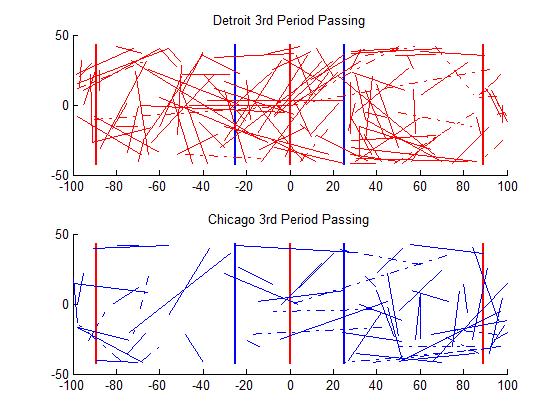
Detchi_passing_medium

Completed passes are represented by solid lines, while incomplete passes are dashed.  Some breakout passes that must have gone along the boards are shown as direct lines from point-to-point, which might look a little funny.

At any rate, there's a lot to come - individual passing; time of possession by zone; analysis of what happened when Detroit pulled Jimmy Howard for 1:22.  If you have any suggestions, please fill up the comment box!

Comment 36 comments  |  5 recs  | 

Do you like this story?

Comments

Display:

I’m falling hard for those passing charts.

Does he call it Luongo underwear?

Co-Manager at Behind the Net

by Bettman's Nightmare on Feb 11, 2011 8:34 AM EST reply actions   1 recs

Definitely agreed.

Geoff has Boosh, Mike's got Powe, Nodl is all mine!
Is this the right room for an argument?

by DLJr on Feb 11, 2011 9:25 AM EST up reply actions  

/swoons

Man-crushin' on Boucher since 1999 and Matt Calvert since May 2010
Broad Street Hockey - Makin' it look mean since 1967.
SB Nation Philly - Associate Editor

by Geoff Detweiler on Feb 11, 2011 9:18 AM EST reply actions  

E. Gao spent 18 hours on this?

That man(or woman) is a hero.

I too, stongly approve of those passing charts.

On the Mike Weber bandwagon (no longer with a lack of stupid boarding penalties!)
All credit for the Sabres incredible THREE game winning streak goes to FloridaBuffalo. (Who has gone hoarse with all his cheering)

by Ubiquitous on Feb 11, 2011 9:21 AM EST reply actions  

18 hours

over the course of about six weeks, haha. It gets pretty hard to focus after five (game) minutes.

by gmh on Feb 11, 2011 6:13 PM EST up reply actions  

wait keep a low profile

My hockey-related comment: Thowing an octopus on the ice is the dumbest meme in professional sports. I'd rather throw waffles.

by puppetmasterp on Feb 11, 2011 10:17 PM EST up reply actions  

err..."way"

My hockey-related comment: Thowing an octopus on the ice is the dumbest meme in professional sports. I'd rather throw waffles.

by puppetmasterp on Feb 11, 2011 10:17 PM EST up reply actions  

I assuem “interceptions” are included among the incompletes?

Blueshirt Banter - Where Rangers' Fans Matter
Tracking the Rangers - Numbers don't lie. They just don't agree with you.
Twitter: RangerSmurf

by George E. Ays on Feb 11, 2011 9:23 AM EST reply actions  

assume even.

Blueshirt Banter - Where Rangers' Fans Matter
Tracking the Rangers - Numbers don't lie. They just don't agree with you.
Twitter: RangerSmurf

by George E. Ays on Feb 11, 2011 9:23 AM EST up reply actions  

how does soccer do it?

The Guardian (and English newspaper site) has something called “chalkboards” that let’s you filter for players, teams, etc in an individual game and let’s you see passing charts, spots on the field for interceptions, etc. Couldn’t the NHL add the same techonology or is it just an army of stat goons recording everything? By the way, I use the word “goon” lovingly.

Ryan

Matchsticks & Gasoline, Hockey Prospectus, &Sports Opinionated. My twitter handle is @sprtopinionated

by SO_RyanP on Feb 11, 2011 9:52 AM EST reply actions  

Those chalkboards are unbelievable. I think that they can do it because they have cameras and systems at field level around the pitch. I know Rafa Benitez at Liverpool was a huge proponent of using those stats.

Pension Plan Puppets: A Toronto Maple Leafs blog and a group therapy session.
Like reading thoughts confined to 140 characters? I'm on Twitter too.

by PPP on Feb 11, 2011 11:00 AM EST up reply actions  

Furthermore soccer is a slower game and hence easier. Also they must have more than one guy doing it

Rebuild is a convenient excuse for GMs who dont wish to do their jobs

by SumOil on Feb 11, 2011 12:26 PM EST up reply actions  

If it’s not done electronically, then it would take way more than one guy to do it. It’s nuts.

Ryan

Matchsticks & Gasoline, Hockey Prospectus, &Sports Opinionated. My twitter handle is @sprtopinionated

by SO_RyanP on Feb 11, 2011 1:39 PM EST up reply actions  

Yeah this is all nice, but does this person even watch the games?

(This is awesome, awesome stuff.)

by Triumph44 on Feb 11, 2011 10:00 AM EST reply actions  

I watched the entire period at 1/4-speed

then double-checked my info at half speed.

by gmh on Feb 11, 2011 6:14 PM EST up reply actions  

Can I assume anything about the portion of the passes that came from a specific area or went to a specific area? Like, for instance, if over half of Chicago’s completed passes stayed within the D-zone, does that mean Detroit had a crazy-good forecheck? I’ve always thought that it would probably take one D→D pass per rush up the ice, even for a dump in, but that if it got to be more than that, a team was having a lot of difficulty getting it out of the zone. In the same sense, will you be analyzing this for the number of passes per possession, of some other derivative?

This is just straight up amazing stuff. Imagine in the future when they finally put a tracking device in the puck and digitize all of this information immediately for every period of every game! Wow. I’m kind of giddy!

Jon Casey fan since '84
Founder of Feel the Teal.
I have a Twitter Thing.

by stufflife on Feb 11, 2011 1:36 PM EST reply actions  

I’d much rather they put a chip in the puck so that it could be shown streaking across the screen like a laser beam. It really helped me track the puck.

Ryan

Matchsticks & Gasoline, Hockey Prospectus, &Sports Opinionated. My twitter handle is @sprtopinionated

by SO_RyanP on Feb 11, 2011 1:38 PM EST up reply actions  

The key though is different colors for different speeds. I mean, when I see a shot, I wanna know if that thing is a blue streak or a fiery red comet.

Lighthouse Hockey: Send us your cold, your poor, your healthy goalies.

by Dominik on Feb 11, 2011 3:07 PM EST up reply actions  

If I’m not mistaken, the glowing puck technology was the basis for the Picth-FX system in baseball.

So don’t laugh too hard. That was a digital process with a data stream somewhere in it. I’d do very bad thing to very nice people to get those data stream.

by Olivier on Feb 11, 2011 4:36 PM EST up reply actions  

I tried to get it last year through some people with real pull, no luck

by Hawerchuk on Feb 11, 2011 4:40 PM EST up reply actions  

The Glow-Puck also became the NFL’s first-down line.

Hockey Blog Adventure: New Post: Year in Review: Your 2010 Boston Bruins. The Good, the Bad, the Loss to Philly (I'm also on Twitter.) GO BRUINS! (and Wild!)

by Cornelius Hardenbergh on Feb 14, 2011 10:57 AM EST up reply actions  

Very cool. Are these just even strength?

by et_pitt on Feb 11, 2011 2:44 PM EST reply actions  

There were no penalties in the 3rd period

by Hawerchuk on Feb 11, 2011 2:49 PM EST up reply actions  

It’s not exactly surprising, but the chart makes it plain as day: the preponderance of LHD results in serious breakout asymmetry. For this reason, I’ve always felt that RHD are more valuable commodities than LHD.

I wonder if there is any evidence that similarly skilled RHD get paid more than LHD.

by sisu on Feb 11, 2011 3:36 PM EST reply actions   1 recs

It would be interesting to see this same chart for a team with 3 RHD.

Editor of The Copper & Blue, and leader of The Cult Of Hartikainen.

by Derek Zona on Feb 11, 2011 5:06 PM EST up reply actions  

Sample includes Lidstrom and Keith, so don’t draw too many general conclusions.

This is great stuff, Gabe.

Writer for The Cult of Hockey, The Copper & Blue, and primary shareholder of Zorg Industries

"Never be ashamed of who you are" -- Jean-Baptiste Emanuel Zorg

by Bruce McCurdy on Feb 11, 2011 10:07 PM EST up reply actions  

Detroit runs their breakout with the RD behind the net, LD stationary along the left wall, and the RW in motion along the right wall. So, their chart would tend to skew toward the left even if they had more RHD, since they’re likely to pass the puck out of the zone if they go up the left wall, but carry the puck out if they go up the right. Of course, more RHD could compell them to run a different setup.

by BrianW on Feb 12, 2011 1:21 AM EST up reply actions  

Detroit's D-zone passes

The success rate of Detroit’s passes in their own zone is incredible – 94%. Hell, I’d say that’s a solid number for just a practice let alone with another team on the ice. Seems like the Hawks were really hanging back there.

What I also found interesting is the Hawks defensive zone and offensive zone passing success rates were equivalent – I would have expected defensive zone passing rates to be more successful than offensive, just due to more aggressive defense being played in a team’s own end (at a minimum, you’d expect some passes in a defensive zone to have no checking at all from the other team due to line changes). But for Chicago, you’ve got a 74% success rate for passes starting in either end. That makes me think Detroit was really being aggressive on the forecheck and hounding them all over the ice.

What also seems weird is that Chicago and Detroit had similar amount of shots (7 shots for Detroit and 6 for Chicago – not sure on shot attempts, as this is the first one I dug up at nhl.com). With all of Detroit’s passes in the offensive end, and with them trailing, I would have thought they’d have peppered a lot more shots than Chicago. Actually, I would have expected Detroit to have a much lower “offensive zone pass per shot” than Chicago, but it seems the inverse is true – it looks like Chicago was the one just shooting at first opportunity while Detroit kept looking for a better scoring chance / keeping possession.

Stupid question on the graph … which end is the defensive versus offensive zone? It looks like -ve distance is your offensive end while +ve distance is your defensive zone (trying to match the passing stats in the chart to number of lines in the graph by eye). If I’m right in that interpretation, it surprises me how many of the Hawks’ passes involve the middle of the ice in their own end. It seems counterintuitive that everything else indicates they’re being forechecked pretty heavily, but then they can have a lot of successful passes from right around the slot in their own end.

by Bourque77 on Feb 11, 2011 5:09 PM EST reply actions  

left end (of both charts) is Detroit’s goal; right end is Chicago

by Hawerchuk on Feb 11, 2011 5:19 PM EST up reply actions  

Ok … so then it’s a pattern for both teams that there are more passes in front of your own net than your opponents (on an absolute basis at least). Not what I would have expected to see at all.

by Bourque77 on Feb 11, 2011 5:40 PM EST up reply actions  

If the pass went off the boards, I don’t know that. So they may not pass in front of their own nets at all

by Hawerchuk on Feb 11, 2011 5:52 PM EST up reply actions  

It was surprisingly fun, though rigorous.

and I might actually go back and look at the first two periods in my free time, just because I knew the score effects (DET being down two goals) would skew the passing/possession data pretty heavily in the third period.

(Am I the only one who finished? I seriously thought I was holding everyone back!)

by gmh on Feb 11, 2011 6:17 PM EST reply actions  

(Am I the only one who finished? I seriously thought I was holding everyone back!)

I don’t know, but you’re definitely pushing things forward. Grea twork.

Devils in my heart! Devils in my mind! Devils in my eyes! Devils until I die!
In Lou We Trust - The New Jersey Devils SBN Blog

by John Fischer on Feb 12, 2011 1:04 AM EST up reply actions  

I’d very much like you guys to publish how you structured the data… If someone else, after reading this post, were to, say, do something like that by themselves, it would be nice to have comparable data sets coming out of it…

Maybe just a sample of the data, say the first 10 touches of the period?

by Olivier on Feb 12, 2011 4:04 PM EST up reply actions  

Comments For This Post Are Closed


User Tools

The finest Winnipeg Jets analysis on the internets

FanPosts


Managers

Hawerchuk_small Hawerchuk

Gary_bettman_bad_dreams_small Bettman's Nightmare

Grapes_small canadian texan

Howe_small TJCAPS

Editors

Ryan_small SO_RyanP

0_small maplestirup

Jets2_small arby_18